
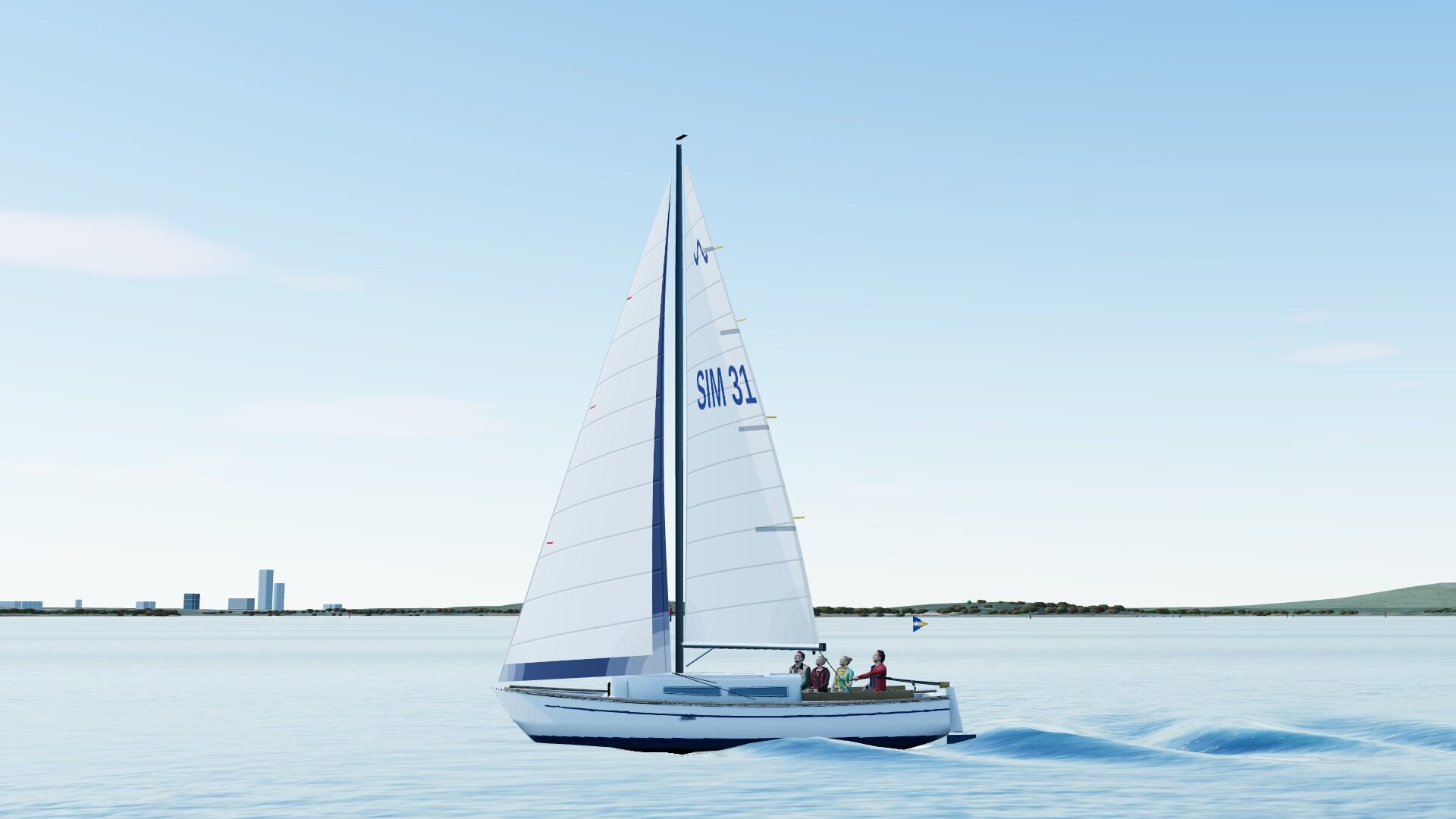
The boat in this book, and in the simulator, is a Chico 30: a 9.3 metre cruiser-racer designed by Gary Mull and built in New Zealand from 1970. She is a sloop, the commonest rig in any marina: one mast and two sails, a mainsail behind the mast and a jib in front of it. Almost everything in this chapter applies equally to a small dinghy or a much bigger yacht.
Finding your way round
The front of the boat is the bow and the back is the stern. Anything towards the bow is forward, and anything towards the stern is aft. Looking forward, the left-hand side of the boat is port and the right-hand side is starboard. These don’t change when you turn round: port is the left side of the boat as you face the bow, whichever way you are facing yourself.
Two old aids to memory: port and left both have four letters, and port wine is red. The navigation lights follow the same pattern, red on the port side and green on the starboard side (Chapter 13).
The width of the boat at her widest point is her beam, and something that is “on the beam” is out to the side, at right angles to the boat. The bow and the quarter are the forward and after parts of each side, so a ship “on the starboard bow” is ahead and to the right, and one “on the port quarter” is behind and to the left.
The hull, keel and rudder
The hull is the body of the boat. Inside it is the cabin, with somewhere to sleep, cook and get out of the weather, and behind the cabin is the cockpit, the open well where the crew sit and from which the boat is sailed. The raised part of the deck over the cabin is the coachroof, and you go below through the companionway, a hatch and steps at its aft end.
Under the hull are two fins. The big one in the middle is the keel, and it does two jobs. Its weight, a large part of the boat’s total weight in lead or cast iron, stops the boat from blowing over; on this boat it is about 2.4 tonnes, more than half of her 4.6 tonnes, held on by keel bolts through the bottom of the hull. Its shape stops her from sliding sideways through the water. The smaller fin at the stern is the rudder, which steers the boat. On this boat the rudder is turned with a tiller, a long handle in the cockpit; bigger boats often have a wheel instead.
Below decks she has a double V-berth in the bow, then the heads (the toilet) to starboard and a hanging locker to port, either side of the mast, a saloon with a table and a settee berth along each side, the galley (the kitchen) to port and the chart table to starboard by the companionway, and a quarter berth under the starboard cockpit seat. The engine is under the companionway steps.
The rig
Everything that holds up and controls the sails is called the rig. The mast stands up from near the middle of the boat and is held in place by wires: the forestay runs from the bow to the top of the mast, the backstay from the top of the mast to the stern, and the shrouds hold it from each side, spread out by short struts called spreaders. This fixed wiring is the standing rigging. On this boat the forestay goes right to the top of the mast, which is called a masthead rig.
The bottom of the mainsail is held out by the boom, a horizontal pole that pivots at the mast. The boom swings from one side of the boat to the other when she tacks or gybes, at head height. Always know where the boom is, and keep your head below it when it may come across.
Sheets, halyards and other ropes
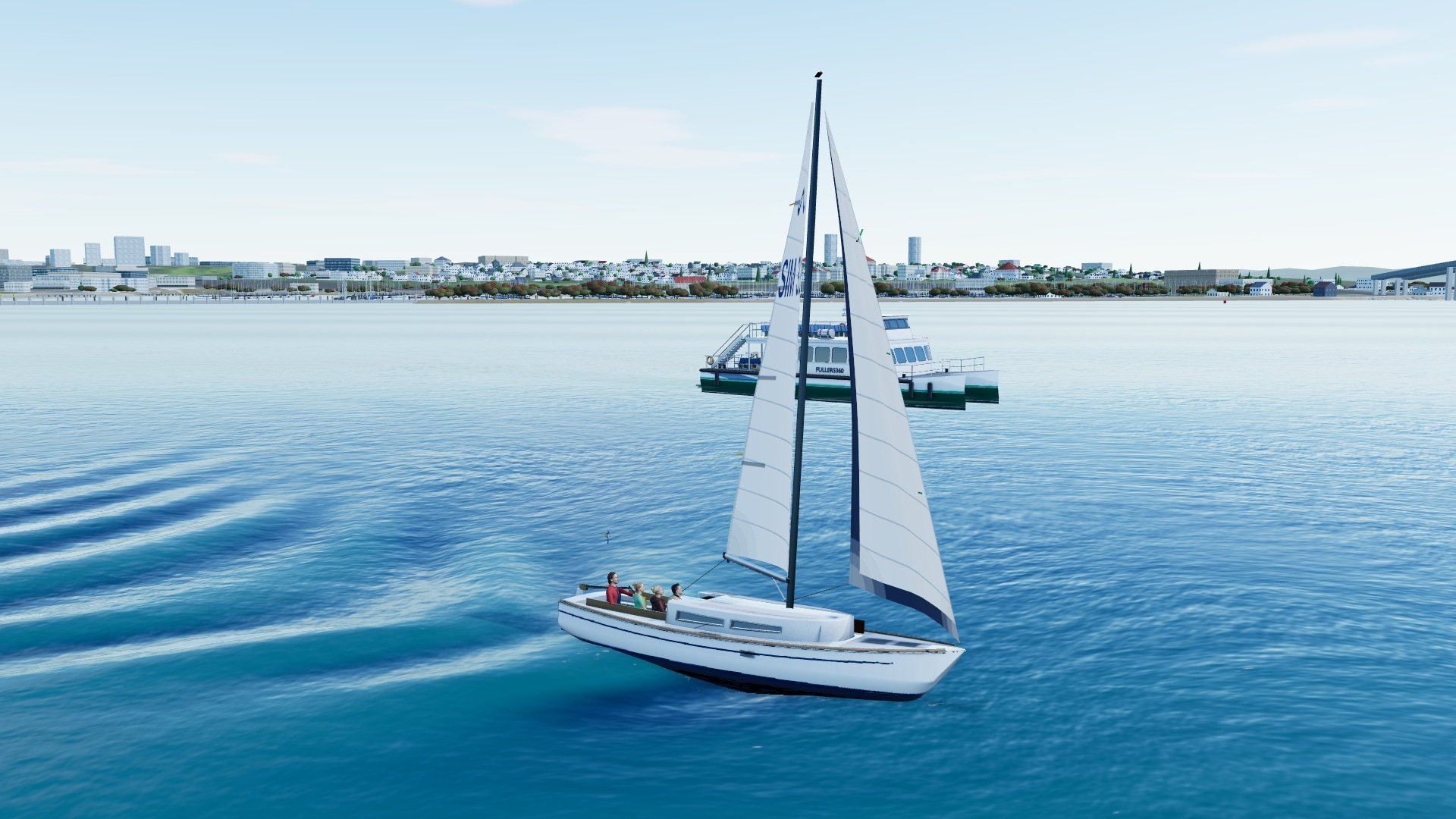
On a boat, ropes are usually called lines, and most of them have their own names. The ropes that pull the sails in and let them out are sheets: the mainsheet controls the boom and the mainsail, and there are two jib sheets, one on each side, for the jib. The ropes that pull the sails up the mast are halyards. All of this moving rope is the running rigging, to tell it apart from the standing rigging.
Pulling a sheet in is called sheeting in or trimming, and letting it out is easing. Most sheets are led round a winch, a drum turned with a handle that gives the crew enough power to hold a sail full of wind, and are held fast in the winch’s jaws, on a cleat or in a clutch once they are set.
The jib sheets run aft from the clew through a block on a car, which slides along a track on the side deck to change the angle of the sheet, then through a turning block to a primary winch beside the cockpit. The mainsheet comes down from the end of the boom to a car on the traveller, a track across the cockpit. The halyards and the other lines that are worked from the cockpit come down the mast and aft along the coachroof to the smaller coachroof winches.
The winches on this boat are self-tailing: jaws on top of the drum grip the tail of the rope, so one person can wind the handle with one hand and keep the other free. Put three or four turns on the drum, always clockwise, take the tail round into the jaws, and wind. The handle has two speeds: one direction is fast, the other slower and more powerful. Take the handle out when you’ve finished, so that it can’t catch a sheet or be knocked over the side.
Each line that goes to a coachroof winch passes through a clutch first. With its lever down, the clutch grips the line and holds it; lift the lever and the line runs free. To adjust a line, put it on the winch and wind until the winch takes the load, then open the clutch, set the line where you want it, close the clutch and take the line off the winch. Never open a clutch on a loaded line until the line is on a winch and the winch has taken the load. Otherwise the line runs out with a jerk, fast enough to burn your hands.
Our boat’s jib is a big one, a genoa, which reaches back past the mast. Many yachts, including this one, have the jib on a furler: the sail rolls up round the forestay like a blind, so it can be set, reduced or put away from the cockpit without anyone going forward.
Windward and leeward
Two more words come up all the time. The windward side of the boat is the side the wind is blowing onto, and the leeward side, pronounced “loo-ard”, is the side away from the wind. The sails normally lie out on the leeward side. When the boat heels, the leeward side goes down towards the water, and the crew usually sit on the windward side to help hold her up.
The same words describe anything around you. A boat that is to windward of you is upwind of you; a buoy to leeward is downwind. Upwind is the direction the wind comes from; downwind is the direction it blows towards.
Check yourself
Answer each one from memory before you look at the answer; recalling it is what fixes it in your mind. Tap an answer to check it.
-
You are steering with a tiller. Which way do you move it to bear away (turn the bow away from the wind)?
Try it in the simWelcome aboardShow the answer
B. Towards the wind (to windward). A tiller works the opposite way to the bow. Move it towards the wind and the bow turns away from the wind; push it towards the sails and she heads up.
-
At night, what colour is the sidelight on a boat’s port side?
Try it in the simWelcome aboardShow the answer
C. Red. Red to port, green to starboard. One way to remember it: port wine is red, and port and left both have four letters.
-
Close-hauled, you bear away onto a reach with the sails trimmed to suit. What happens to her speed?
Try it in the simWelcome aboardShow the answer
A. She speeds up. Close-hauled, much of the sails’ pull heels her and pushes her sideways. On a reach more of it drives her forwards, so she speeds up: for most boats the beam reach is the fastest point of sail.
-
Holding a steady course, what works best on the helm?
Try it in the simWelcome aboardShow the answer
C. Small, early corrections. A boat takes a moment to answer the helm. Small corrections made early keep her straight; big late ones make her snake about.