
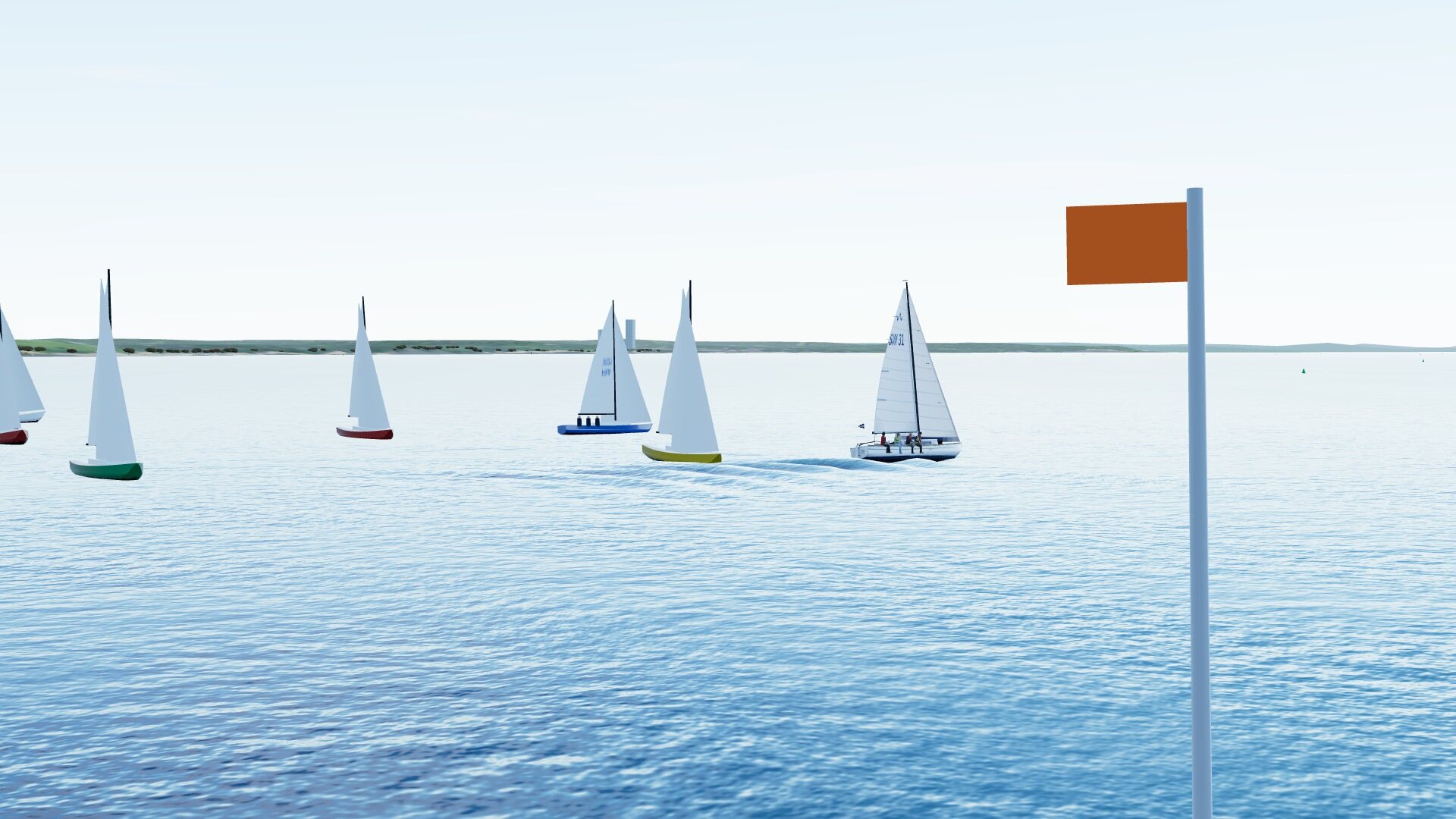
Most club races follow the same pattern: a start, a beat to a windward mark, a run back to a leeward mark, perhaps another lap, and a finish. Racing uses everything in the earlier chapters, and adds some rules of its own.
The start sequence
A race begins with a countdown, signalled with flags and sounds from the committee boat (rule 26). The warning signal goes at five minutes, with the class flag raised; the preparatory signal at four minutes, when the preparatory flag, usually flag P, goes up; at one minute the preparatory flag comes down with a long sound; and at the start the class flag comes down. The times are taken from the flags, so if a sound signal is late or missing, go by the flag. Start your watch on the five-minute signal, and check it at four.
The start line
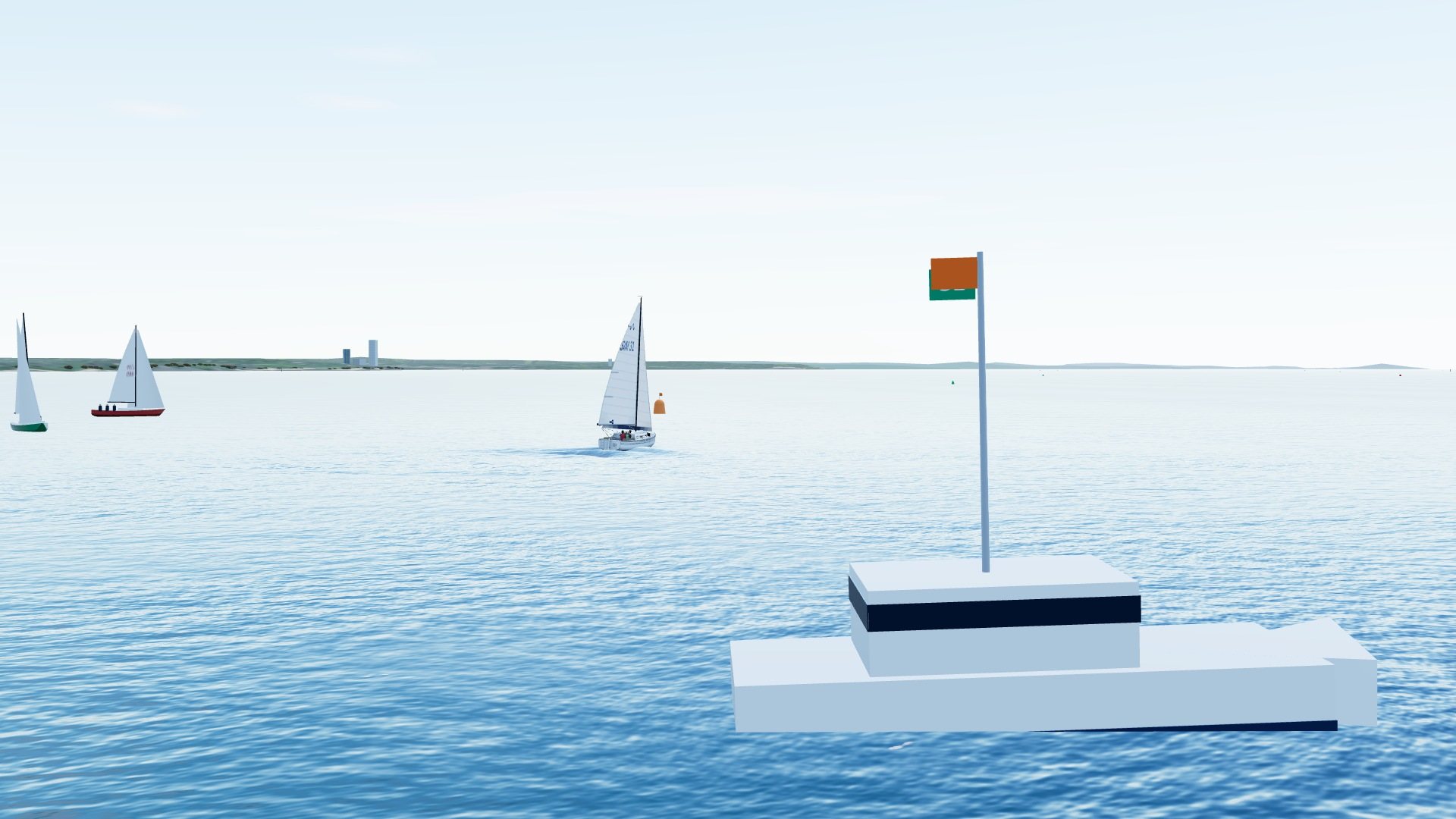
The start line runs between a staff with an orange flag on the committee boat at one end and a buoy, called the pin, at the other. It’s rarely exactly square to the wind, and the end that’s further upwind is called the favoured end, because it’s closer to the windward mark. To find it, sail to the middle of the line and luff head to wind; the end your bow points more towards is favoured. Starting there gives you a head start, so most of the fleet will try to start there too.
A timed run
The aim is to cross the line at full speed, just as the start signal goes. A simple way to do it is a timed run:
- With a few minutes to go, sail away from the line on a reach for a set time, say one minute.
- Tack or gybe, and sail back towards the line. The run back takes about the same time, plus the time the turn takes.
- Adjust: if you’re early, let the sails out to slow down; if you’re late, pull them in and go.
- In the last seconds, pull the sails in, come up to close-hauled and cross the line at full speed as the start signal goes.
Keep a gap to leeward, so you have room to bear away and accelerate, and keep an eye on the boats around you. Coming in on starboard tack gives you right of way over boats on port, which makes a crowded start simpler.
Over early
If any part of your hull is over the line when the start signal goes, you’re on the course side, or OCS. The committee will usually fly flag X with one sound (rule 29.1), and you have to go back to the pre-start side of the line and start again, keeping clear of everyone who started properly. Going back costs a great deal of ground.
The racing rules
Racing has its own rules, the Racing Rules of Sailing, published by World Sailing; the current edition runs from 2025 to 2028. Between boats that are racing, or are in the racing area intending to race, they replace the right-of-way rules of the collision regulations, even if the boats are in different races. With any other vessel, from a cruising yacht to a ferry, the collision regulations still apply. The basics are the same ones you already know: port keeps clear of starboard (rule 10), windward keeps clear of leeward (rule 11), and a boat clear astern keeps clear of one clear ahead (rule 12). On top of those, at a mark an outside boat must give mark-room to a boat overlapped inside her, from the time the first of them comes within three hull lengths of the mark (rule 18). A boat that may have broken one of these rules can take a penalty on the water (rule 44): she gets well clear of other boats as soon as she can, then makes two turns, each including a tack and a gybe. Touching a mark is a one-turn penalty. If there’s a dispute, it’s settled ashore in a protest hearing.
| When | Who keeps clear |
|---|---|
| Opposite tacks | the port-tack boat |
| Same tack, overlapped | the windward boat |
| Same tack, not overlapped | the boat clear astern |
| Tacking | a boat that is tacking keeps clear of one that isn’t |
| At a mark | outside boats give mark-room to boats overlapped inside them, from three hull lengths out |
Clear air
The air behind and to leeward of a boat’s sails is slower and disturbed, for several boat lengths. Sailing in it, in dirty air, costs you speed and height, and it is a common reason for a boat to slip back through a fleet. If you’re losing speed close behind another boat, tack or bear away to find clear air. On the first beat, sail in clear air and tack only when you need to, because every tack costs some distance.
Check yourself
Answer each one from memory before you look at the answer; recalling it is what fixes it in your mind. Tap an answer to check it.
-
While you are tacking (past head to wind until close-hauled), what must you do?
Try it in the simThe racing rulesShow the answer
A. Keep clear of other boats. Rule 13: a boat tacking keeps clear. Tacking too close in front of someone is a classic foul.
-
On port tack, a starboard-tack boat is crossing ahead of you. How can you keep clear?
Try it in the simRules on the waterShow the answer
D. Bear away and pass behind her stern, or tack early. Duck behind her or tack well before she has to alter. Rule 10: port keeps clear of starboard.
-
What is the signal at four minutes before the start?
Try it in the simThe startShow the answer
B. The preparatory signal: flag P goes up. Five minutes: warning (class flag). Four: preparatory (P). One: P comes down with a long sound. Zero: the start.
-
You are just behind and to leeward of another boat, and slowing down. Why?
Try it in the simYour first raceShow the answer
A. You are in her wind shadow: tack away or bear away into clear air. The air behind another boat’s sails is slow and disturbed. Clear air is worth more than a few metres.