
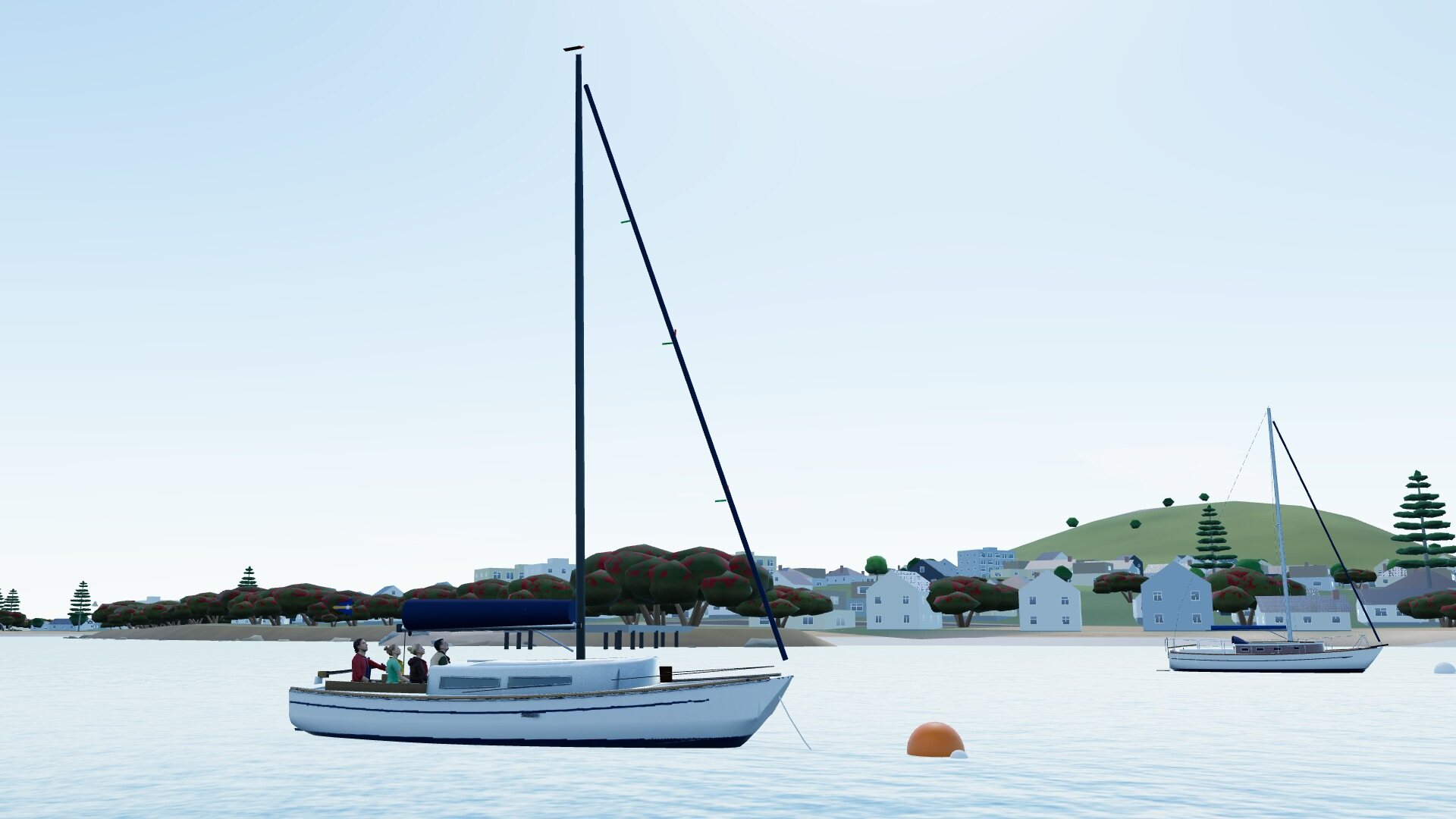
An anchor holds a boat by digging into the seabed, and it holds best when it is pulled along the bottom rather than upwards. That is why you let out plenty of chain, and why you set the anchor by going gently astern.
Choosing a spot
Look for a place that is sheltered from the wind and the waves, both now and from the direction the forecast gives for later. The bottom should be sand or mud, which an anchor digs into well; rock and weed hold badly. Check the chart for the depth and the type of bottom, for cables and other things you mustn’t anchor on, and for how much the tide will rise and fall. Leave room: the boat will swing round her anchor as the wind and tide change, and so will every other boat in the bay.
How much to let out
The length of chain or rope between the boat and the anchor is called the rode, and the amount let out compared with the depth is the scope. With all chain, let out at least four to five times the depth; with rope, seven to eight times. Measure the depth at high water, and add the height of the bow above the water. In strong winds let out more.
With enough scope, the weight of the chain makes it lie along the seabed, so that the pull on the anchor is horizontal, which digs it in, instead of upwards, which pulls it out.
Anchoring, step by step
- Motor slowly into the spot you have chosen, heading into the wind or the tide, whichever is stronger (the way the boats already anchored are lying), and stop.
- Lower the anchor to the bottom, and let out chain as the boat drifts back, so that it lies along the seabed rather than in a heap on top of the anchor.
- When you have let out about three times the depth, hold the chain on the windlass (the anchor winch), never in your hands, and let the boat’s weight dig the anchor in.
- Let out the rest of the scope, then go gently astern under engine to set the anchor firmly.
- Check that you’re holding: pick two objects ashore that line up, a transit, and watch that they stay lined up.
- At night, show an all-round white anchor light; by day, a black ball in the rigging.
Picking up a mooring
A mooring is a heavy weight on the seabed with a chain up to a buoy, laid permanently for a boat to tie to. Every mooring belongs to someone, so use one only with the owner’s permission; in Auckland, tying up to one without it can earn a fine. To pick one up, look at how the boats on nearby moorings are lying, and approach slowly the same way, heading into the wind or the tide, whichever is stronger, so that you stop with the buoy at the bow. The crew on the foredeck points at the buoy throughout, because the helmsman loses sight of it under the bow in the last few metres, and picks up its line with a boathook. Make it fast to the bow cleat, and check that you are lying comfortably before you switch off the engine.
Knots for mooring
The knots for making the boat fast are in Chapter 2: a cleat hitch for a mooring line on a cleat, a bowline for a loop to drop over a bollard or a post, and a round turn and two half hitches to tie to a ring. Shackle the anchor to its chain, and wire the shackle’s pin so that it can’t unscrew.
Check yourself
Answer each one from memory before you look at the answer; recalling it is what fixes it in your mind. Tap an answer to check it.
-
Before you pick up a mooring, what tells you which way to approach it?
Try it in the simPicking up a mooringShow the answer
C. The way the moored boats are lying. Moored boats lie head to the stronger of wind and tide. Approach the same way, and it acts as your brake.
-
What makes a good anchorage?
Try it in the simAnchoringShow the answer
D. Shelter, good holding (sand or mud), a sensible depth and room to swing. Like Cheltenham Beach in a south-westerly: sheltered by the Devonport shore, sand, 5 to 8 m, and room to swing.
-
Where should the buoy be when you stop?
Try it in the simPicking up a mooringShow the answer
A. At the bow, where the crew can reach it with the boat hook. Stop with the buoy at the bow. Under the boat its line can foul the keel, rudder or propeller.
-
With all chain, how much do you let out for 4 to 1 scope in 5 m of water, with 1 m from the water to the bow?
Try it in the simAnchoringShow the answer
B. 24 m. 4 × (5 + 1) = 24 m. Use 5 to 1 or more if it is windy, and much more with rope.