
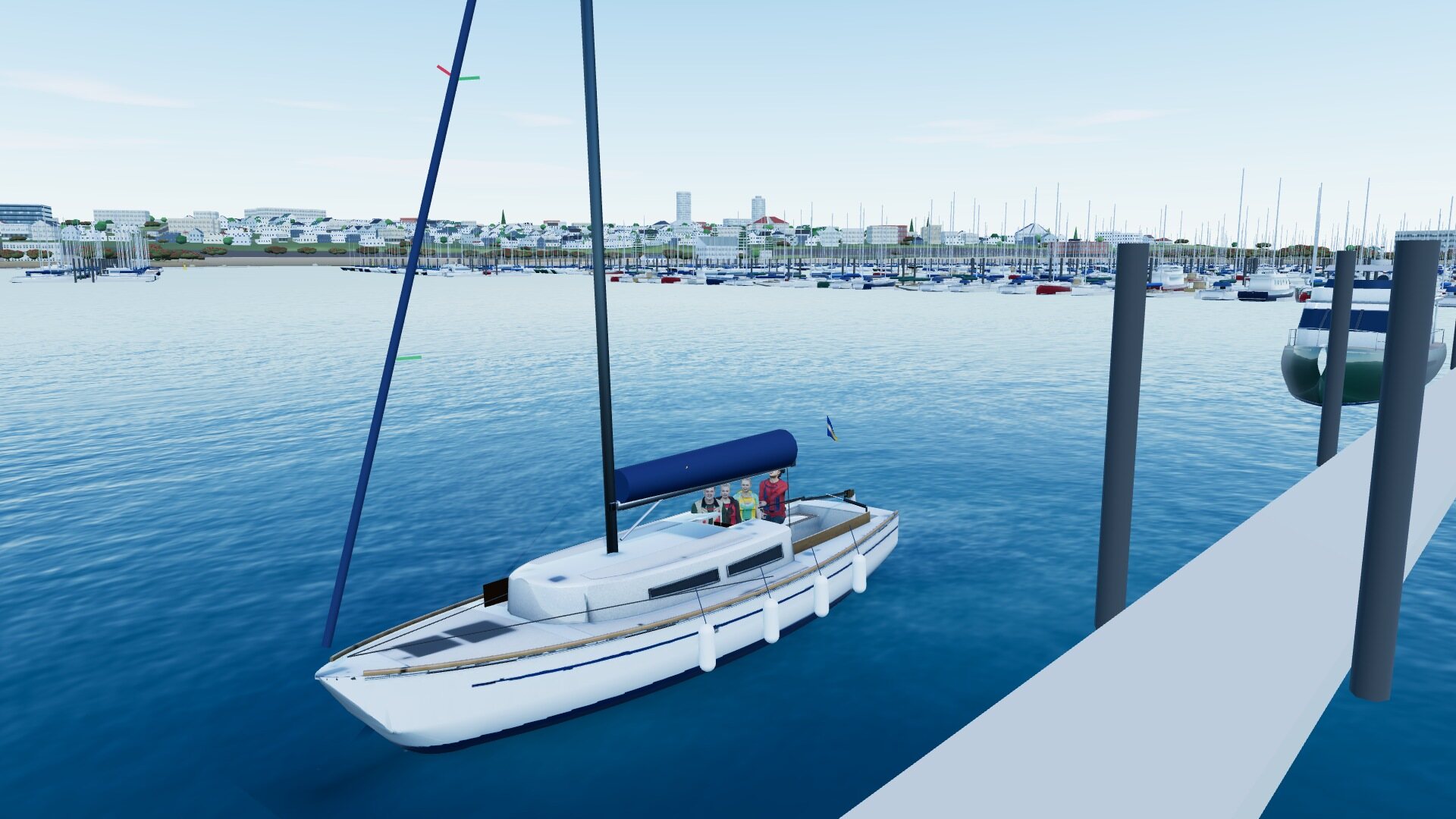
A boat has no brakes. The only way to stop her quickly is to put the engine astern, and even that takes time and distance, so in a marina you go slowly.
The engine
The gear lever has three positions: ahead, neutral and astern, and on most boats the same lever is also the throttle. Always pause in neutral for a moment when changing between ahead and astern, to let the propeller slow down before the gearbox engages the other way. Before starting the engine, check that no lines are trailing in the water near the propeller, and once it’s running, look over the stern to check that cooling water is coming out of the exhaust.
Prop walk
A propeller doesn’t only push the boat forwards or backwards. Because it’s turning, it also pushes the stern sideways a little. Going ahead the effect is small, and as soon as there’s water flowing over the rudder you can steer it out. In reverse it’s much stronger, and until the boat has picked up speed astern the rudder can do little about it. On most boats, including this one, the stern kicks to port when you go astern; on some it goes to starboard.
Find out which way your own boat walks, in open water, before you need to know. You can then use it: if the stern walks to port, come alongside with the pontoon on your port side, and a short burst astern will both stop the boat and pull her stern in towards the pontoon.
Leaving a berth
With no wind, leaving a berth is a matter of letting the lines go and motoring gently out. When the wind is blowing you onto the pontoon it is harder: let go and motor ahead, and the wind holds you against the pontoon, so you grind along it and into the boat in front. The answer is to spring off.
- Put a fender right forward on the bow.
- Take in all the lines except the bow spring, which runs from the bow aft to a cleat on the pontoon. Rig it as a slip line, from the bow round the cleat and back aboard, so that it can be let go and pulled in from the boat and nobody is left on the pontoon.
- Steer the bow in towards the pontoon (with a tiller, push it away from the pontoon) and motor gently ahead against the spring. The spring stops the boat moving forward, so the bow pivots on its fender and the stern swings out.
- When the stern is well clear, go to neutral, slip the spring and pull it aboard, clear of the propeller, centre the tiller and motor firmly astern, out into clear water.
Coming in
Coming back in, keep the speed right down. Approach at a slow walking pace, about one and a half knots or less. A short burst of power will help you steer when you need it, but speed cannot be taken off quickly. If you can, come in heading into the wind or the tide, whichever is stronger, so it helps you stop.
Put the fenders out and get the lines ready well before you arrive: made fast on board, coiled, and led through their fairleads and outside the lifelines, so the crew can step ashore with them. When you reach the berth, a short burst astern stops the boat. Step off with the middle line, or a spring, first: it holds the boat close while the bow and stern lines go on. Never jump; step off when the boat is alongside and nearly stopped.
Check yourself
Answer each one from memory before you look at the answer; recalling it is what fixes it in your mind. Tap an answer to check it.
-
Why pause in neutral when changing between ahead and astern?
Try it in the simMotoring and prop walkShow the answer
C. It is kinder to the gearbox. A moment in neutral lets the propeller slow before the gearbox takes up the other way.
-
What do you do before casting off the lines?
Try it in the simLeaving the berthShow the answer
D. Start the engine and check cooling water is coming from the exhaust. If the engine won’t start, or isn’t cooling, you want to find out while you are still tied up.
-
How do you stop the boat at the pontoon?
Try it in the simComing alongsideShow the answer
B. A short burst astern. Come in slowly, then a short burst astern takes the last of her way off.
-
Does more speed give you more control in a marina?
Try it in the simBerthing in the marinaShow the answer
C. No: things happen faster and she takes much further to stop. At walking pace a mistake is a gentle touch; at speed it is damage. The usual mistake is coming in too fast.