
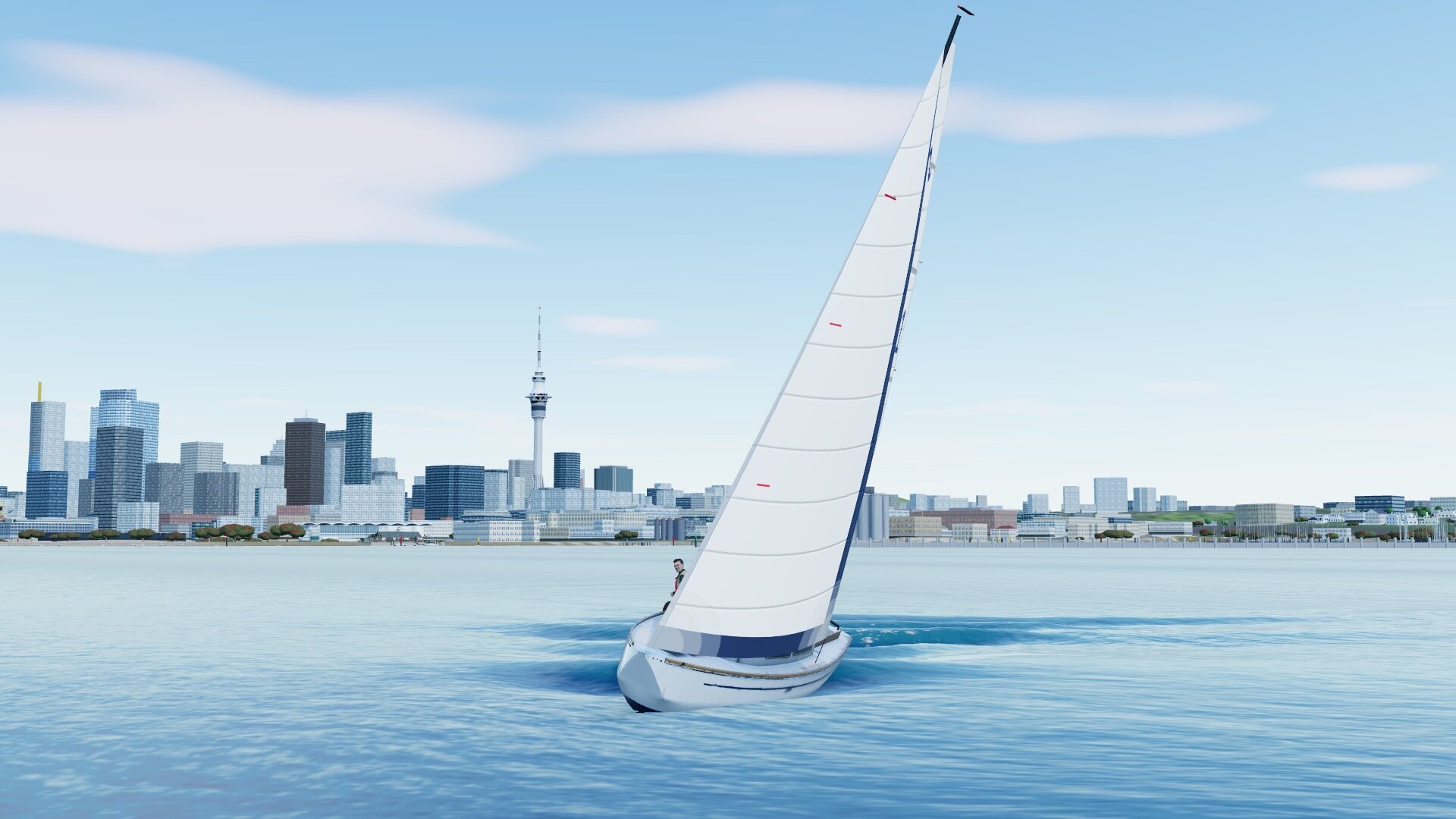
Sailing downwind is easy to understand: the wind pushes on the sails, and the boat goes with it. A sailing boat can also go across the wind, and make progress towards it, and to do that her sails work like the wing of an aircraft.
Lift
When a sail is set at a small angle to the wind it takes up a curved shape, a bit like the wing of an aeroplane stood on its end. The wind splits at the front edge of the sail, the luff, and flows round both sides. The air flowing round the curved, leeward side of the sail is turned to follow the curve, and as it does so it speeds up and its pressure drops. (It isn’t because it has further to go: the air on the two sides doesn’t have to meet again at the back.) On the windward side the air slows a little and its pressure rises. The difference in pressure between the two sides produces a force called lift, at right angles to the wind, which pulls the sail towards its leeward side and slightly forwards.
A sail set like this is pulled by the low pressure on its leeward side more than it is pushed by the wind on its windward side. Lift is what lets a boat sail across the wind and towards it, and it is why she sails faster on a reach than on a run, where the wind is simply pushing her along.
Drive and side force
The pull of the sail doesn’t point in the direction the boat is going. Only part of it, the drive, points forwards; most of it pushes the boat sideways. Without something to resist that sideways push, the boat would slide away across the water.
That is the keel’s job. A deep fin is very hard to push sideways through the water, but it slips forwards easily, so it resists the side force and leaves the drive to move the boat ahead. The keel works as a wing in the water: as the boat moves it meets the water at a small angle, and produces its own lift, sideways, against the side force from the sails.
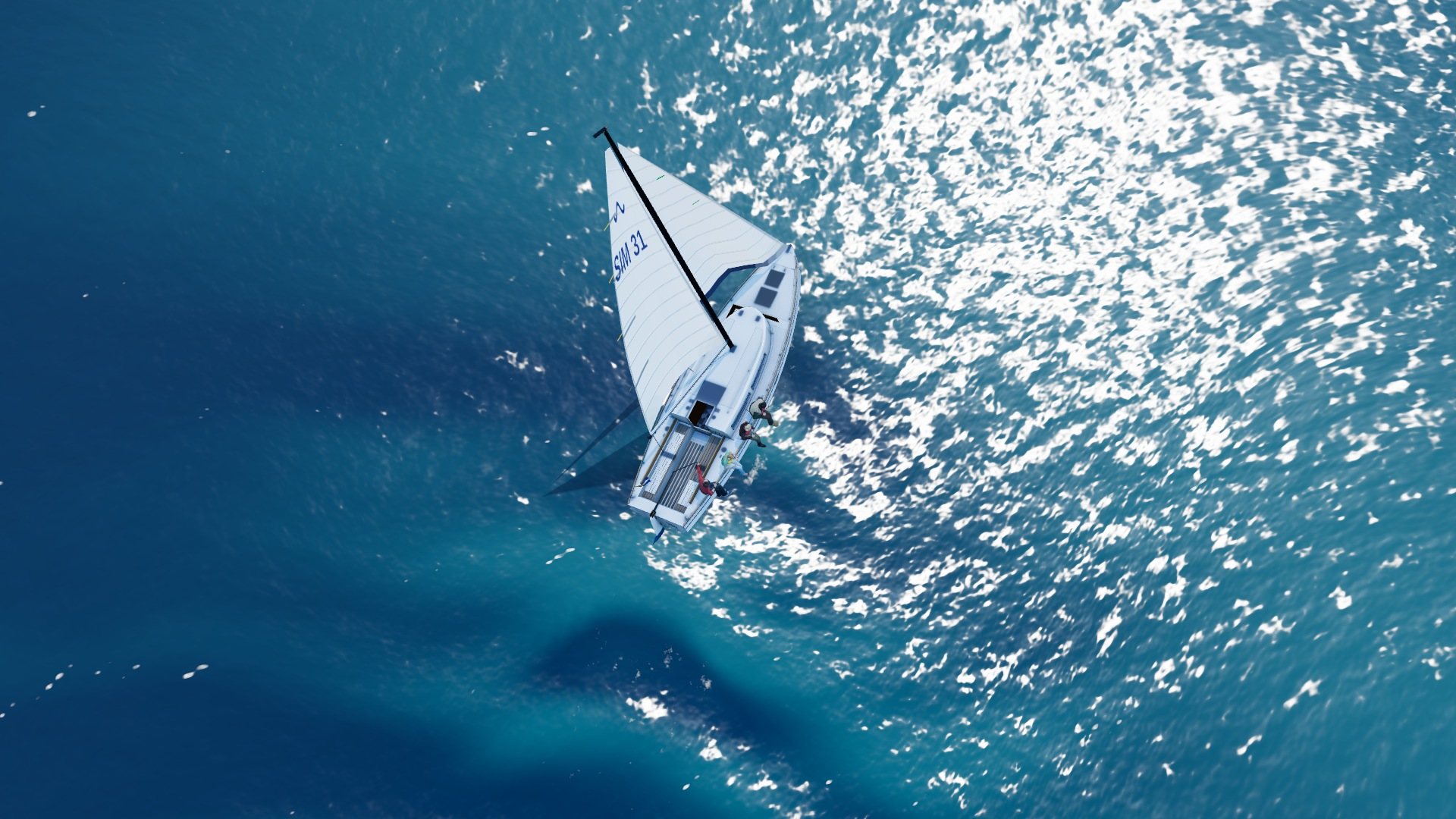
The boat still slides sideways a little as she goes, a few degrees off the line she is pointing along. This is called leeway. You can see it in the wake, which trails away slightly to windward of the line of the boat, and the small angle it makes is the angle at which the keel meets the water.
Apparent wind
As soon as the boat moves, she makes a wind of her own. Standing on deck in a flat calm while the boat motors at five knots, you would feel a five-knot breeze from straight ahead. Under sail, that breeze combines with the wind blowing over the water, the true wind. The wind you feel on board, and the one the sails work in, is the combination of the two, and is called the apparent wind.
Except on a dead run, the apparent wind comes from further forward than the true wind. When you sail towards the wind it is also stronger than the true wind, because your own speed adds to it. When you sail away from the wind your speed takes away from it, and it feels lighter; on a dead run it comes from the same direction as the true wind, weaker by the speed of the boat. So a breeze that feels gentle on a run can feel strong when you turn round to sail home against it.
Heeling
The side force from the sails acts well up the mast, while the keel resists it far below the water. Together the two forces try to tip the boat over, and she heels, leaning away from the wind.
What stops her going over is mainly the keel’s weight. As she heels, the heavy keel swings out to windward, and its weight pulls the boat back towards upright, harder the further she leans. The shape of the hull helps as well: as she heels, her leeward side is pressed deeper into the water and its buoyancy pushes it back up. At some angle the heeling and righting forces balance, and she sails along steadily, heeled over. The crew add to the righting force by sitting on the windward side.
Some heel is normal, but more heel does not mean more speed. Once a boat like this heels past about 20 degrees, the sails present less area to the wind, the keel and rudder lose their grip, and she becomes hard to steer. Chapter 10 covers what to do about it.
Check yourself
Answer each one from memory before you look at the answer; recalling it is what fixes it in your mind. Tap an answer to check it.
-
Close-hauled, you bear away onto a reach with the sails trimmed to suit. What happens to her speed?
Try it in the simWelcome aboardShow the answer
A. She speeds up. Close-hauled, much of the sails’ pull heels her and pushes her sideways. On a reach more of it drives her forwards, so she speeds up: for most boats the beam reach is the fastest point of sail.
-
Why does the top of the mainsail need some twist?
Try it in the simSail shape: twist, flat and the travellerShow the answer
B. The wind is stronger aloft and comes from further aft up there. Higher up the wind is stronger, so the apparent wind there comes from further aft. A little twist lets each part of the sail meet its own wind.
-
Is a boat heeled right over going faster?
Try it in the simReefing in a blowShow the answer
C. No: past about 20 to 25° she slows, slips sideways and is hard to steer. Heeled hard, the sails spill wind and the keel and rudder lose their grip. With a reef in she sails flatter and faster.
-
Roughly how close to the true wind can this boat sail?
Try it in the simPoints of sailShow the answer
B. About 45°. For about 45° either side of the wind is the no-go zone: point in there and the sails flap and she stops. Close-hauled is just outside it.