
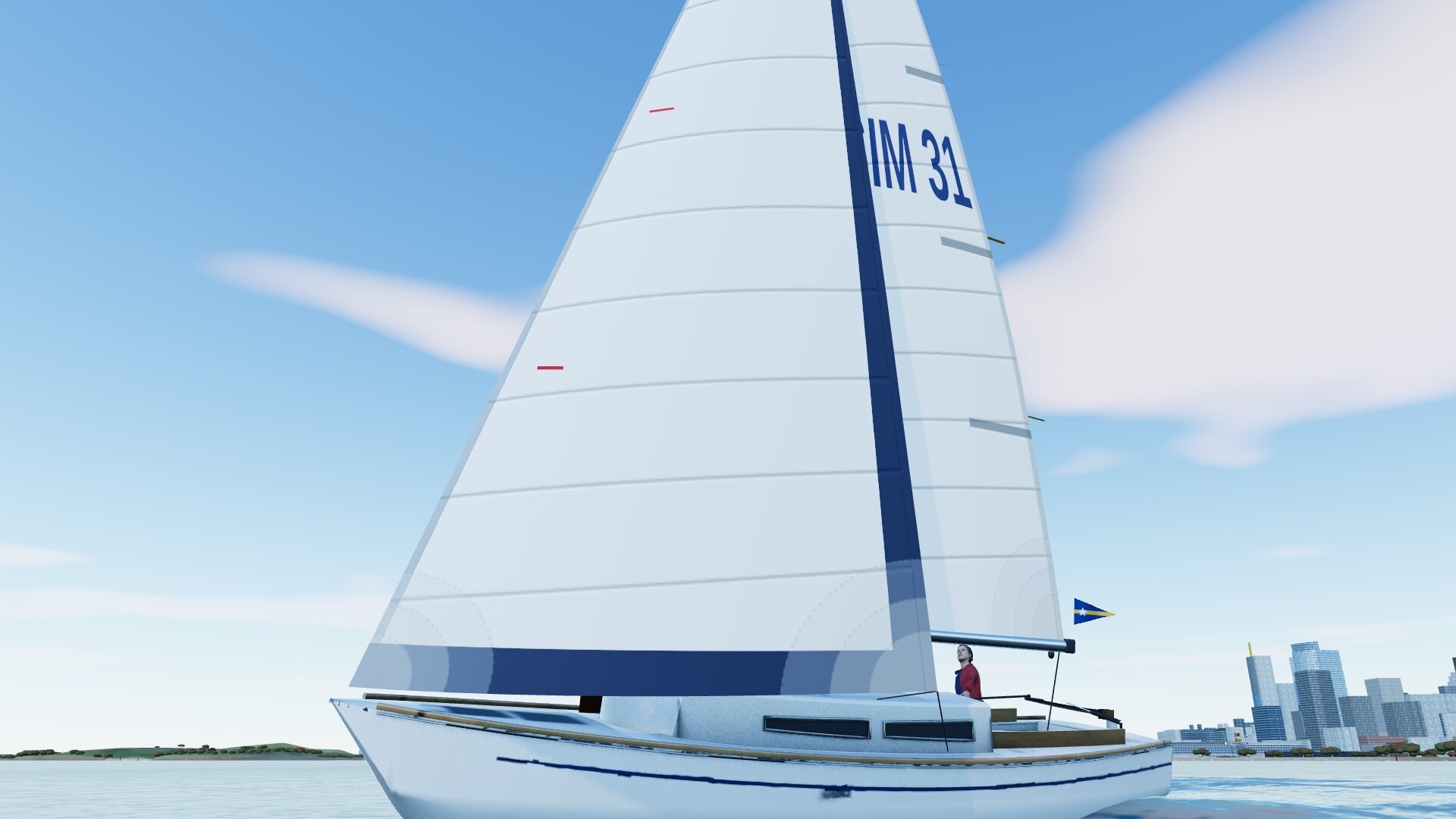
Trimming means adjusting the sails to suit the wind. The rule in the last chapter gets the sails roughly right, but the wind is always changing a little in strength and direction, and to set them well you need to be able to see what the air is doing.
Telltales
Telltales are short pieces of wool or ribbon attached near the luff of the jib, one on each side of the sail. Most jibs have two or three pairs at different heights, and the sail is thin enough that you can see the far one through it. On the boat in the simulator the port telltales are red and the starboard ones green.
When both telltales stream straight back along the sail, the air is flowing smoothly over both sides and the sail is producing as much drive as it can.
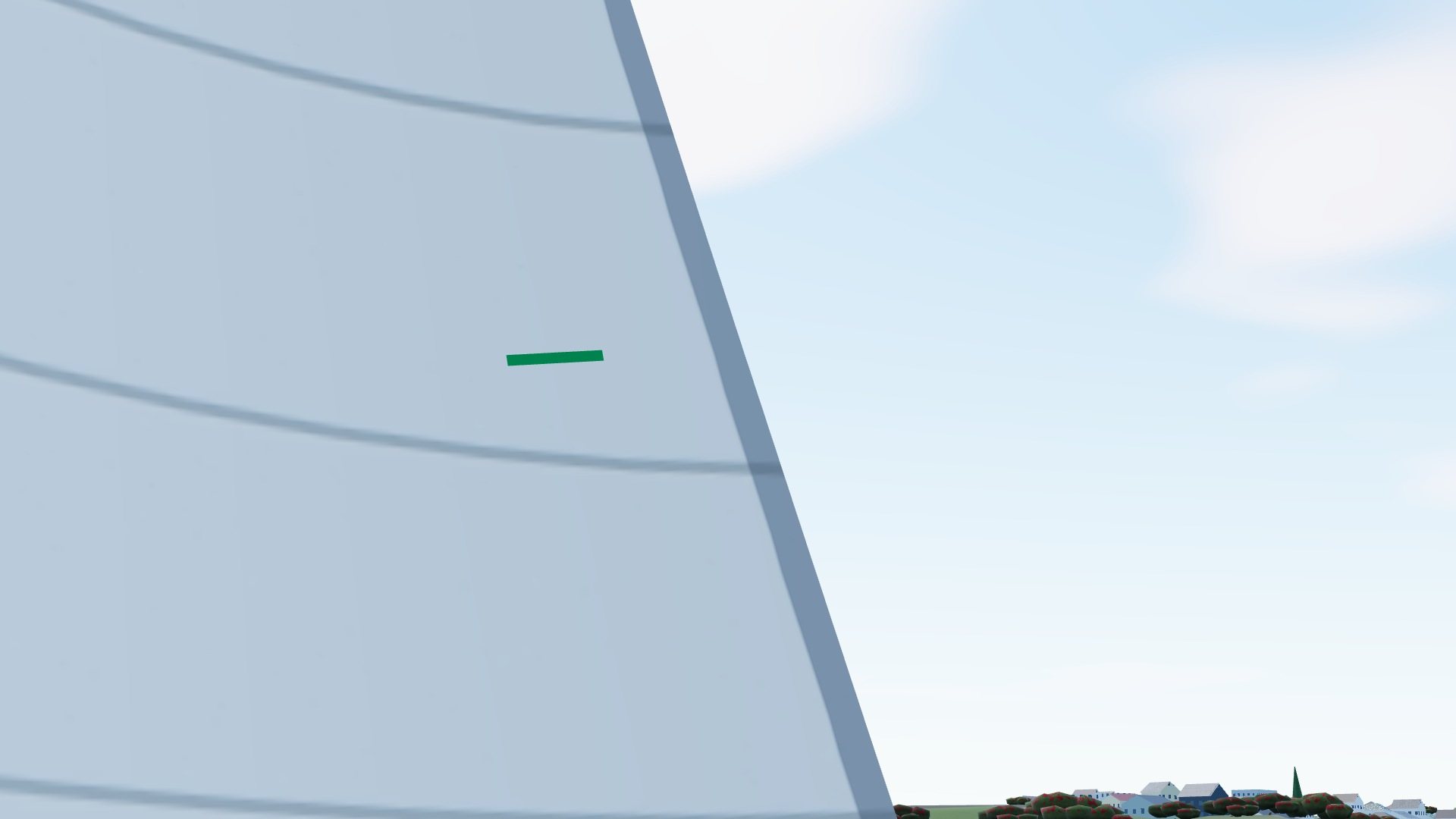
Eased too far: the windward telltale lifts
If the sheet is let out too far, the angle between the sail and the wind is too small. The wind starts to strike the luff on its leeward side, the flow breaks away from the windward side just behind the luff, and the windward telltale lifts and flutters. Let the sheet out further and the luff curls back and flaps. Pull the sheet in until the telltale streams again.
Pulled in too tight: the leeward telltale droops
The opposite mistake is more common and harder to spot. When the sheet is pulled in too far, the air on the leeward side can’t follow the curve of the sail. It breaks away from the back of the sail, and the sail stalls. The leeward telltale droops, or spins round. The sail still looks full and powerful, and the boat may heel a bit more, but she’s slower. Ease the sheet until the telltale streams.
If you are not sure, let the sail out until the windward telltale just starts to lift, then pull it back in a little.
Steering by the telltales
When you’re close-hauled, the sails are already pulled right in, so you can’t trim them any further. Instead, you steer by the telltales. If the windward one lifts, you’re too close to the wind: turn away slightly. If the leeward one droops, you’ve turned too far away: turn back towards the wind slightly. Small movements of the tiller are enough, and an experienced helmsman does this continually.
| You see | It means | Off the wind: trim | Close-hauled: steer |
|---|---|---|---|
| Both streaming | Just right | Leave it | Hold your course |
| Windward one lifting | Sail too far out, or too close to the wind | Pull the sheet in | Turn away from the wind a little |
| Leeward one drooping | Sail stalled: too far in, or too far off the wind | Ease the sheet | Turn towards the wind a little |
The parts of a sail
Every sail has three corners and three edges. The top corner is the head, the bottom front corner is the tack, and the bottom back corner is the clew, where the sheet is attached. The front edge is the luff, the back edge is the leech, and the bottom edge is the foot. The mainsail’s leech is usually stiffened by battens, flat strips slid into pockets across the sail.
The mainsail often has telltales too, on its leech. When they stream out behind the sail the main is trimmed well; when they keep disappearing round behind it to leeward, the leech is too tight and the mainsheet or kicker should be eased.
Sail shape
Once the sails are at the right angle to the wind, the next thing is their shape: how deep the curve of the sail is, and how much it twists from the bottom to the top.
A deep, full sail gives a lot of power, which is what you want in light winds and choppy water. A flat sail gives less power and less drag, which is what you want when it’s windy and the boat is heeling too much. On the mainsail, pulling the outhaul, the cunningham and the backstay tight all make it flatter.
The true wind is stronger higher up, so aloft the apparent wind comes from further aft, and the top of the sail should be set a little further out than the bottom. This is called twist. The mainsheet and the kicker, or vang, control it by holding the boom down: pull the kicker on to straighten the leech and add power, let it off to let the top of the sail open and spill wind. The kicker matters most off the wind, when the mainsheet is eased and no longer pulls the boom down. The traveller moves the boom across the boat without changing the twist. Letting the car down to leeward, which sailors call dropping the traveller, is a quick way to depower in a gust.
Balance
A well-trimmed boat should be balanced: if you let go of the tiller she should turn slowly up towards the wind, and a little pressure on the tiller should keep her straight. A boat that pulls hard to windward, with the tiller held well to windward, has too much weather helm, usually because the mainsail is pulled in too hard or she’s heeling too much. Ease the mainsheet or drop the traveller, and she will be easier to steer and faster.
Check yourself
Answer each one from memory before you look at the answer; recalling it is what fixes it in your mind. Tap an answer to check it.
-
The windward telltale on the jib is lifting and fluttering. What do you do?
Try it in the simTrimming the sailsShow the answer
C. Pull the sheet in, or bear away. The windward telltale lifts when the front of the sail is starting to luff: the sail is too far out for your heading. Trim in, or bear away, until it streams.
-
It is blowing 20 knots and she is overpowered close-hauled. What do you do to the mainsail’s shape?
Try it in the simSail shape: twist, flat and the travellerShow the answer
C. Flatten it: outhaul, cunningham and backstay on. A flatter sail makes less lift and much less drag, so less heel. Dropping the traveller to leeward helps too.
-
How do the jib’s telltales look when the sail is trimmed right?
Try it in the simTrimming the sailsShow the answer
A. Both streaming straight back. Both streaming means the air flows smoothly over both sides of the sail, and it is making as much drive as it can.
-
Light air and a leftover chop. What shape of sail do you want?
Try it in the simSail shape: twist, flat and the travellerShow the answer
A. Fuller (deeper), with some twist. A deeper sail is more powerful and more forgiving in light air and waves: ease the flattening, bring the traveller up and ease the vang so the top can twist with the wind.